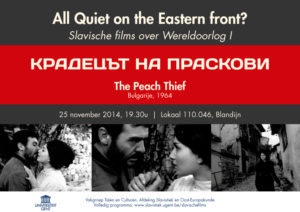
Bulgarije, 1964 – Vulo Radev
Wereldoorlog I loopt op zijn einde. Bulgarije, dat meestrijdt met Oostenrijk-Hongarije, is aan de verliezende kant. Er heerst onvrede bij de soldaten, de Servische troepen dreigen vanuit Griekenland door te stoten. Ivo, een Servische krijgsgevangene, probeert te ontsnappen uit een Bulgaars kamp en komt terecht in een privétuin. Daar ontmoet hij Lisa, de echtgenote van de burgemeester, een strenge en harteloze kolonel. Lisa en Ivo worden verliefd, maar hun relatie is gedoemd door de snel veranderende omstandigheden.
Bulgarije, 2017 – Kristina Grozeva & Petar Valtsjanov
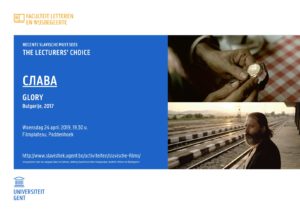
Na hun eerste grote bestseller Urok (The Lesson, 2015) halen de regisseurs Kristina Grozeva en Petar Valtsjanov met Slava hun tweede kaskraker binnen, waarmee ze nationaal en internationaal in de prijzen zijn gevallen. In deze tragikomedie boordevol zwarte humor en fatalisme komt de zelfvoldane en ambitieuze pr-verantwoordelijke van het Bulgaarse ministerie van Transport Joelija Stajkova tegenover de stotterende en teruggetrokken spoorwegmedewerker Tsanko Petrov te staan. Tsanko vindt een zak geld op de spoorlijn en bezorgt de zak in alle eerlijkheid aan de autoriteiten. Dankzij zijn goede daad kan een groot corruptieschandaal rond de minister van Transport omzeild worden, dus besluit Joelija daar gretig gebruik van te maken…
Rusland & Nederland, 2017 – Aliona van der Horst
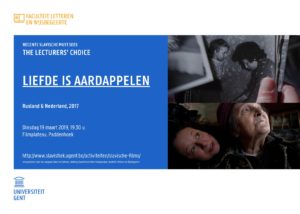
In Liefde is aardappelen bezoekt Aliona van der Horst na de dood van haar moeder haar Russische familie, omdat ze mede-erfgenaam is van het houten familiehuis op het platteland. Ze spreekt er met haar overgebleven tantes, haar nichten en neef en reconstrueert door die gesprekken, en door oude brieven van haar moeder, het familieverleden. Langzaam maar zeker vormt zich een aangrijpend beeld, niet enkel van dat gruwelijke verleden dat getekend werd door de hongersnood op het platteland in de Stalintijd , maar ook van de wijze waarop ieder van de overlevenden dat verleden probeert te verwerken. Liefde is aardappelen is een zeer persoonlijke film, maar evenzeer is het een document van zijn tijd dat op indringende wijze de ontberingen van de boerenbevolking in de Stalintijd schetst.
! De documentairemaakster zal zelf ook aanwezig zijn, voor een kort interview voor de film én een discussie erna !
Servië, 2016 – Srdja Penezić
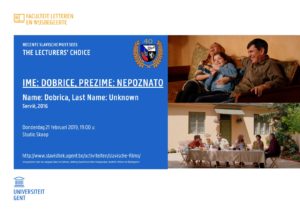
Ime: Dobrica, prezime: nepoznato is een feelgoodfilm of zelfs een sprookje voor volwassenen. Het hoofdpersonage, Dobrica, wordt als baby op een vuilnisbelt achtergelaten. De vondeling wordt eerst door twee oude mensen opgevoed, maar later wordt hij door de staat in een weeshuis geplaatst. Ondanks alle ellende die hij in zijn leven meemaakt, blijft Dobrica – de naam betekent ‘goed mens’ – toch geloven dat iedereen goed is, en dat wie slecht is gewoon het goede voorbeeld moet krijgen. Uiteindelijk wordt Dobrica verliefd op een drugsverslaafde.
De film werd bijzonder warm ontvangen in Servië en daarbuiten. De hoofdrol wordt vertolkt door Slavko Štimac, die een dertigjarige filmcarrière achter de rug heeft (met onder meer rollen in films van Emir Kusturica). In Ime: Dobrica worden er fragmenten gebruikt uit verschillende van zijn eerdere films, waardoor deze film ook een eerbetoon is aan de laatste echte Joegoslavische filmster.
Toegang is gratis, maar inschrijven verplicht via deze link.
Slovenië, 2017 – Janez Burger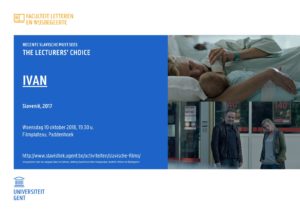
Ivan is een film over de levenskeuzes die iedereen moet maken in de moderne, chaotische wereld. De film begint met Mara, het hoofdpersonage (gespeeld door Maruša Majer), die een buitenechtelijk kind op de wereld zet. Ze is obsessief verliefd op de vader van het kind, Rok – een getrouwde, corrupte zakenman die beticht wordt van witteboordencriminaliteit. Mara raakt betrokken in een gewelddadige corruptiezaak en komt terecht in een vluchthuis. Wanneer Rok belooft om haar en hun liefdesbaby mee te nemen naar een veilige plaats, is ze ervan overtuigd dat alles goed komt. Rok heeft echter andere plannen: hij wil alleen maar zijn geld veiligstellen. In hun vlucht wordt Mara gedwongen een onmogelijke keuze te maken: tussen haar pasgeboren zoon en de man waar ze zielsveel van houdt.
Ivan was een hit op vele filmfestivals en werd bekroond met verscheidene prijzen: Beste speelfilm en Beste vrouwelijke hoofdrol op het Festival van de Sloveense Film in Portorož en nogmaals Beste vrouwelijke hoofdrol op het Filmfestival van Pula. Maruša Majer was ook een van de tien “shooting stars” van het Filmfestival van Berlijn van 2017. Regisseur Janez Burger kreeg al meer dan veertig Sloveense en internationale prijzen.
Matija Ogrin (Slovenska Akademija Znanosti in Umetnosti, Ljubljana)
The greater part of Slovenian literature has come into existence during the Early Modern and Modern period, i.e. in the era of printed books. But, surprisingly, many Slovenian texts of Early Modern time never succeeded to enter the medium of what we now call the print culture – for several historical reasons, ranging from material to ideological. Nevertheless, these texts had their own public and reception, their own ways of reproduction and dissemination – by means of what we call the manuscript culture. In this way, numerous manuscripts of hymnals, meditative prose and other devotional literature (Erbauungsliteratur), and even Jesuit drama in Slovenian language, were not supported by the printing press and the book market. Instead, they continued to fulfill their cultural mission and function in the medium of manuscript culture – as a separate, manuscript layer of literature. In some areas of the Slovenian literary system, this was the case as long as until the mid 19th century.
These manuscript literature is an ideal object for research approaches, using the methods of Digital Humanities. The lecture gives an outline of the analysis and description of manuscripts for the Register of Early Modern Slovenian Manuscripts that rely on Text Encoding Initiative Guidelines (TEI).
Aneta Dimitrova (Universitet im. Kliment Ohridski, Sofia)
Zlatostruy (“Golden Stream”) is a renowned collection of sermons translated from Greek into Old Church Slavonic in Bulgaria in the 10th century. It is believed that the Bulgarian Tsar Symeon (893–927) himself selected the texts to be translated – he singled out some of the best sermons from the works of St. John Chrysostom (c. 347–407) on topics such as sin and penitence, good and evil, prayer, vigilance, almsgiving, etc. After that (anonymous) translators and editors rendered the sermons into Old Church Slavonic and grouped them more or less thematically. Several generations of professionally trained scribes copied and sometimes edited the translations. The Zlatostruy Collection was widely spread among the Slavs and was modified according to its audience – the sermons were sometimes revised, rearranged, or abridged. This was the path of many literary works in the medieval Slavonic literature – selection, translation, adaptation to the audience.
In my lecture I will present the Zlatostruy Collection as one of the best examples of translated patristic literature in medieval Bulgaria. I will discuss briefly its history, contents, and its most interesting features, and I will try to answer the following questions: What was interesting and what was unfamiliar to the Slavonic audience? How did the original texts change due to revisions and mistakes? What was Zlatostruy’s influence in the following centuries? The most interesting cases of adaptation and incorrectly translated passages in Zlatostruy will be given as illustration.
Maria Grazia Bartolini (Università degli studi di Milano)
This study concerns the use of visual paratexts in seventeenth-century Ukraine, and of illustrated title pages in particular. The books under analysis represent three crucial monuments of seventeenth-century Ukrainian sacred oratory. These are: Lazar Baranovych’s Truby sloves propovidnykh na narochityia dni prazdnikov (Kyiv, 1674), Antonii Radyvylovs’kyi’s Ohorodok Marii Bohorodytsy (Kyiv, 1676) and his Vinets Khrystov (Kyiv, 1688). I concentrate on the “cognitive” aspect of their titular pages, dealing with them as a rhetorical process that emphasizes meditation, invention, and memory. More specifically, I investigate the correlation between the visual and the written as a specific literary-figurative “mode of thought” that stands in a long Christian tradition of expounding images as meditational tools. I will show how Baranovych and Radyvylovs’kyi interact with this tradition, arguing that their title pages provide readers-viewers with both a machina meditativa, a meditative apparatus for reflecting upon the mystery of the Incarnation, and a machina rhetorica, a repertory of images that the users of the books, often themselves preachers, could use to compose new texts.
Jan Fellerer (University of Oxford)
The Polish-Lithuanian Commonwealth (1569-1795) was ethnically and linguistically highly diverse. Many were East Slavs who spoke Belarusian and Ukrainian dialects. Besides Church Slavonic for religious writing, they used an unstable amalgam of vernacular Ukrainian and Belarusian, Church Slavonic and Polish for administrative purposes. The beginnings of this so-called prosta mova, often referred to as ‘Ruthenian’ in English, date back to the 14th c., but its usage and linguistic profile changed and developed considerably since the 16th c., to include many new domains, such as religious writing and literary prose. It is usually assumed that the prosta mova was falling out of use over the 18th c. due to the increasing dominance of Polish throughout the Commonwealth.
After sketching the trajectory and linguistic profile of the prosta mova during its early modern heyday, I shall argue that it did, however, not disappear together with the Polish-Lithuanian Commonwealth. Its legacies continued well into the 19thc., in particular in texts by Ukrainians from Galicia, the part of the former Commonwealth that was annexed by the Habsburgs. By then, their mixed written language was labelled jazyčie, ‘gibberish’. Its ultimate demise was only towards the end of the 19th c., when the new, vernacular-based Ukrainian written language gained general acceptance throughout all Ukrainian lands, including Galicia. To what extent the prosta mova played a role in the inception of new written Ukrainian too, remains a question for further research.
Diana Atanasova (Universitet im. Kliment Ohridski, Sofia)
The presentation focusses on textual amulets, a specific type of texts spread in the Medieval and Pre-Modern Bulgarian tradition. These are texts written or engraved on different material – lead, parchment, paper – with the intention to be worn on the body. It was commonly believed that, if one obtained such a text, written on anything, and carried it with him, the text would provide enough protection against diseases and evil powers. It was sufficient to own these texts, while reading them was not required.
The texts found on amulets comprise spells, incantations, lists of names, magical prayers, but also narratives – shorter and expanded. The main issue of my presentation is to discuss the meaning and the principle of selection of these narratives, known also as historiola. What kind of stories did they tell and were they reproduced only on such apotropaic objects?