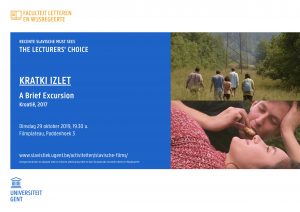
 Kroatië, 2017 – Igor Bezinović
Stola’s vriendin Laura heeft het voor de derde en nu echt laatste keer uitgemaakt. Zijn zomer is een lange, lome aaneenschakeling van bandjes kijken, overmatig drankgebruik, seks in de bosjes en gesprekken over alles en niks. Maar op een dag komt hij Roko tegen, een oude bekende, die op zoek is naar middeleeuwse fresco’s in een nabijgelegen klooster. Roko overtuigt Stola en een willekeurige groep feestgangers om met hem mee te gaan op zijn zoektocht. Wanneer hun bus op een afgelegen plek defect raakt, verandert hun korte excursie in een allegorische reis naar het onbekende.
Deze film won heel wat prijzen , onder andere de ‘Best Director Award’ en ‘Young Critics Jury Award’ op het Russische Andrey Tarkovsky International Film Festival van 2017; en ‘Best Film’ in de ‘Brave Balkan Competition’ op het Servische Auteur Film Festival van 2017.
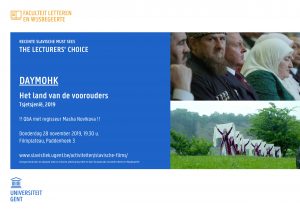
Rusland & Nederland, 2019 – Masha Novikova
De documentaire Daymohk (Het land van de voorouders) vertelt het verhaal van de Tsjetsjeense sterdanser en choreograaf Ramzan Achmadov wiens dansgroep Daymohk onderdak heeft gekregen bij de huidige president van Tsjetsjenië, Kadyrov. Daarmee is de dreiging voor uitsterven van de eeuwenoude volksdans voorlopig even voorbij. Maar het offer is groot: Ramzan heeft zijn dochter Aminat moeten afstaan aan Kadyrov die haar tot zijn derde echtgenote maakte, en de jonge dansers van de groep zijn privébezit van de president geworden. In een poging de traditie van zijn land te redden, offert Ramzan het liefste wat hij heeft.
! De documentairemaakster zal zelf ook aanwezig zijn, voor een gesprek na de film (geleid door Helen Saelman)!
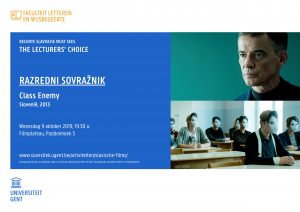 Slovenië, 2013 – Rok Biček
De film speelt zich af in een Sloveense middelbare school en is gebaseerd op een waargebeurd verhaal. De sfeer in een van de klassen is verre van perfect, maar wanneer een nieuwe leraar Duits komt, beginnen de problemen pas echt. De leerkracht, Robert, is streng, veeleisend, heeft geen kaas gegeten van pedagogie en schept er plezier in de scholieren te vernederen. Wanneer een van de meisjes uit de klas zelfmoord pleegt, is het hek van de dam. De leerlingen beschuldigen Robert ervan dat hij het meisje, Sabina, tot zelfmoord heeft gedreven. Ze revolteren tegen het systeem en de leerkrachten, overtuigd dat ze alle antwoorden hebben. Maar hebben ze echt de juiste antwoorden? Is alles echt zo zwart-wit?
Class Enemy werd warm ontvangen op vele filmfestivals en is bekroond met verscheidene prijzen, waaronder de ‘Fedeora Award’ (International Critics’ Week, Venetië, 2013); zeven prijzen op het Festival van de Sloveense film (2013), en vier prijzen op het Filmfestival van Bratislava (2013).
Begin je volgend jaar aan de opleiding Oost-Europese Talen en Culturen en kan je niet wachten om te beginnen of zie je wel iets in een vlottere doorstart? Of wilde je altijd al Russisch studeren, maar vond je nog geen passend format? Schrijf je dan in voor de initiatiecursus Russisch die de opleiding Oost-Europese Talen en Culturen in samenwerking met het Universitair Centrum voor Talenonderwijs (UCT) en de opleiding Toegepaste Taalkunde organiseert. Meer informatie vind je op de Webpagina van het UCT en in een interview waarin de organisatoren meer toelichting geven over de cursus.
Fabienne Bossuyt (UGent)
Given the ongoing tensions between the EU and Russia, only few experts will give serious thought to the prospect of trilateral cooperation on connectivity between the EU, China and Russia in Central Asia. Nevertheless, as China further embarks on implementing its Belt and Road Initiative, and remains firmly set on pursuing the ambitious goal of connecting China overland with Europe, the EU and Russia – as indispensable stakeholders for any Eurasian land bridge to successfully materialize – have been developing policy responses to China’s initiative that reveal an unexpected willingness to cooperate. In scrutinizing the likelihood of cooperation on connectivity between the EU, China and Russia in Central Asia, this lecture identifies the common interests between the three sides, and highlights to what extent cooperation between them is possible in Central Asia. In doing so, the lecture points to the main opportunities while outlining the main bottlenecks, which mostly stem from these actors’ diverging beliefs and approaches to connectivity and development.
Registreer
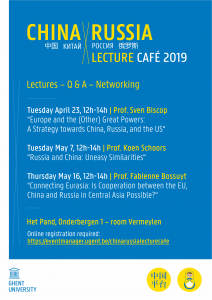
Koen Schoors (UGent)
While Russia is an electoral autocracy, China is just an autocracy. Several observers have argued that this difference constitutes the main reason why China has been growing much faster than China. In this reading of the facts, the combination of political autocracy and proper economic rules would provide an economic model for the future, with Singapore and Dubai as main role models. I defend the reverse position. In Russia, bureaucratic promotion is increasingly based on loyalty and the political leadership of the country has not been renewed for 20 years now, leading to stagnation. China has been economically more successful than Russia in recent decades, precisely because it managed to mimic some characteristics of democracies. The current Chinese leadership is abandoning these characteristics. China is starting to exhibit uneasy similarities with its big Russian neighbour. Stagnation will infallibly follow.
Registreer
Sven Biscop (UGent)
The course of world politics is determined by the interaction between great powers. Those powers are the US, the established power; Russia, the declining power; China, the rising power; and the EU, the power that doesn’t know whether it wants to be a power. If the EU does not just want to undergo the policies of the other powers it will have to become one itself, but it should differ in its strategy. The EU has the means to pursue a distinctive great power strategy, a middle way between dreamy idealism and unprincipled pragmatism, and can play a crucial stabilizing role in this increasingly unstable world.
Registreer
Prof. Dr. G. Tihanov (Queen Mary, University of London)
The poetry of Bulgarian writer, translator and literary critic Geo Milev (1895-1925) embodies the complexities of European modernism through its aesthetic and conceptual journey from symbolism to expressionism. Milev’s poem Ad (Hell) was published three years before his untimely death at the hands of the Bulgarian police in 1925. The presentation explores the poem in the context of the European avant-garde.
Dr. Adelina Angusheva (University of Manchester)
The lecture explores both didactic and polemic textual and visual representations of the witches in the pre-modern Balkan cultural context focusing closely on the works of Josef Bradati (a monk from Rila Monastery), Nikodemos Agioretos (a monk from Mont Athos), and the images of the witches on the external church walls in some of the major Bulgarian monasteries (such as Rila and Troyan).
Miriam Lexmann, IRI Beacon Project
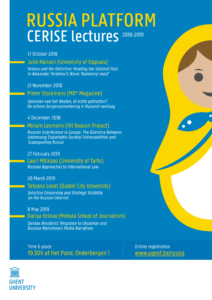
This lecture seeks to inform the current discourse about what many analysts refer to as a “hybrid” warfare between the Russian Federation/Russia and the West. It will particularly focus on the EU’s security modalities with respect to Russia, and more precisely discuss the threat that stems from disinformation and Russian attempts to exploit existing societal vulnerabilities and democratic deficit for its geopolitical aims.
The lecture will argue that simply blaming and securitizing Russia for exploiting loopholes and gaps in our democratic system is insufficient, and merely exaggerates the challenge facing us. Instead, the answer requires a holistic approach that shifts away from the perception of disinformation as merely requiring technical solutions, such as fact-checking, or simply blaming internal or external actors such as Russia, and moves towards a deeper political debate on both the Member-States and European-level.
Miriam Lexmann is the Director of EU Regional Programmes of the International Republican Institute. Prior to that, she served as the Permanent Representative of the Slovak Parliament to the EU. As a Member of the Advisory Board of the University of Kent COMPASS project, Miriam advises academics and practitioners on research and programmes focusing on better governance and capacity-building in the EU neighborhood. Ms Lexmann regularly publishes on topics relating to international democracy support and Central and Eastern Europe. In her latest publications and lectures, Miriam captures various causes of disinformation and its eroding impact on liberal democracy. Miriam hold a master’s degree in Philosophy. You can follow her on Twitter @MiriamMLex.
Online registration required